Expert electrical advice from our NICEIC registered team
Written by Tim, NICEIC registered with 18+ years experience in Poole & Dorset · 5-star Google reviews · Same-day fixed quote, no obligation.
BCP Council EICR enforcement in 2026: civil penalties up to £40,000 per breach (and breaches stack per property), 28 days to fix C1/C2/FI defects, 7 days to supply the report when the council requests it, and the first five-year renewal wave is expiring now, because most certificates were issued 2020–21. A landlord EICR from us costs £150 for a typical 2–3 bed across BH1–BH11: book via our EICR Bournemouth page. Below is what BCP actually enforces and the six mistakes that trigger fines.
If you rent out property in Bournemouth, Poole, or Christchurch, 2026 is the year your EICR compliance is most likely to come under scrutiny. The Electrical Safety Standards in the Private Rented Sector (England) Regulations 2020 came into force on 1 July 2020 for new tenancies, with a transition period for existing tenancies that ended on 1 April 2021. Most certificates issued in that first wave are valid for five years, which means the first major renewal deadline is hitting now.
BCP Council’s housing enforcement team actively checks these regulations. Civil penalties are up to £40,000 per breach, multiple breaches can stack on the same property, and unlike some compliance areas where enforcement is light-touch and complaint-driven, BCP treats private rented sector electrical safety as a priority. They inspect, they request evidence, and they issue remedial notices and financial penalties.
This guide is a practical breakdown of what BCP Council actually enforces, the six specific mistakes that trigger fines, and what Bournemouth landlords need to do right now. It is written from a NICEIC electrician’s perspective. We carry out landlord EICRs across BH1 to BH11 every week, and work regularly with managing agents handling enforcement correspondence.
TL;DR: BCP Council EICR Enforcement at a Glance
- 2026 is the first major renewal year: five-year certificates issued 2020–2021 are expiring
- Civil penalties up to £40,000 per breach: multiple breaches possible per property
- Remedial timeline: 28 days for C1, C2, and FI coded defects
- Tenant copy: 28 days from inspection completion
- Council copy: 7 days from written request
- EICR must be signed by a competent person registered with NICEIC, NAPIT, or equivalent
The Electrical Safety Standards Regulations 2020 applied to all new private tenancies from 1 July 2020 and all existing tenancies from 1 April 2021. Most certificates issued in that first wave are valid for five years, which means we are now at the point where the earliest certificates are expiring, and the rest of 2026 will see the bulk of the 2021 wave reach their five-year anniversary.
BCP Council does not operate on complaints alone. They have a proactive inspection programme, particularly for licensed HMOs in areas like Boscombe, Winton, Charminster, and Springbourne. They respond to letting agent compliance audits, tenant reports, and neighbour complaints. We see evidence of this in our weekly workload. Landlords who booked their first EICR in early 2021 are scheduling renewals now, often prompted by their managing agent flagging the five-year anniversary.
If your EICR was issued in 2020 or 2021, check the inspection date. If the five-year expiry has passed, your property is out of compliance from the moment the certificate expired, not from the date BCP Council decides to check.
Most landlord guides still quote the old £30,000 maximum. It changed. The Electrical Safety Standards (Amendment) (Extension to the Social Rented Sector) Regulations 2025 (SI 2025/1043) amended the 2020 Regulations with effect from 1 November 2025 for private landlords, and three of its changes matter directly in Bournemouth:
The same instrument extends EICR duties to social housing: new social tenancies from 1 December 2025, existing ones from 1 May 2026, with first inspections due before 1 November 2026. That adds thousands of BCP-area social homes to the same inspection pipeline private landlords use. That’s another reason not to leave your renewal to the last minute, because electrician capacity will tighten as those deadlines land.
Across the inspections and enforcement correspondence we see on behalf of landlords and agents, these are the six specific failures that trigger penalty action.
The most serious failure, and the easiest to avoid. Every privately rented property in England must have a valid EICR before tenants move in. This applies to:
Exemptions are limited (lodgings where the landlord shares the property, some social housing, long leases of seven years or more). For practical purposes, if you receive rent for someone to live in the property, you need an EICR.
First-offence civil penalties for no certificate typically fall in the £5,000 to £10,000 range based on reported enforcement outcomes nationally, with BCP Council issuing higher penalties where the non-compliance is sustained or combined with other breaches.
An EICR is valid for a maximum of five years. Some reports specify shorter intervals, for example three years where significant C2 defects were rectified but the overall installation is older. Whatever interval the inspecting electrician specified on the certificate, that is your expiry date.
The day after expiry, you are non-compliant. There is no grace period, no 30-day buffer, no “as long as you’ve booked the next one” argument that works. If BCP Council requests your EICR on day 1,826 and the certificate expired on day 1,825, the certificate is no longer valid.
This is the issue we expect to see most often in 2026: landlords with certificates issued during the 2020–2021 rush who have not diarised the renewal.
When an EICR reports a C1 (danger present, risk of injury), C2 (potentially dangerous, urgent remedial action required), or FI (further investigation required) code, remedial work must be completed and confirmed within 28 days of the inspection date. For C1 codes the expectation is immediate: typically same-day isolation of the hazard before the electrician leaves the property.
The 28-day rule is strict. It is the remedial work completion date that counts, not the date you booked the follow-up visit. We recommend landlords arrange for remedial work to be carried out either during the EICR itself, if the defects are minor and our electrician has the necessary materials on the van, or within the first seven days of the 28-day window to allow for complications.
A failed EICR that has not been remedied within 28 days is a compliance failure even if the original certificate was in date. The law requires both: a valid certificate and completed remedial work.
Tenants must be given a copy of the EICR within 28 days of the inspection. This applies to:
A simple email with the PDF attached is sufficient. Many landlords assume the letting agent handles this. In most cases they do, but the legal responsibility sits with the landlord, and a tenant can report non-provision directly to BCP Council.
Keep the email thread. It is the simplest evidence of compliance if BCP ever queries it.
If BCP Council requests a copy of your EICR in writing, you have seven days to provide it. These requests typically arrive as part of a wider housing standards inspection, an HMO licence renewal review, or in response to a tenant complaint.
The seven-day clock runs from the date of the request, not the date you see the email. Landlords who receive enforcement correspondence while away or during a busy period often miss this window, and the penalty for non-provision stacks on top of any other compliance failures.
An EICR must be carried out and signed by a qualified person. In practice, this means a competent electrician registered with a recognised scheme:
An EICR signed by an unqualified person is not a valid certificate, even if the inspection appeared thorough. If you have any doubt about the qualifications of the person who carried out your last EICR, check their certification number against the scheme’s online register before relying on the certificate for compliance. BCP Council do verify certification numbers on request.
Need a BCP-compliant EICR in Bournemouth? Message Tim on WhatsApp with your property postcode and he’ll confirm availability within the week and give you a fixed price, including any obvious remedial work, before booking. NICEIC registered. Reports provided within 48 hours of inspection.
A valid EICR is more than a box-ticking exercise. To satisfy BCP Council, the document must include:
An EICR that says simply “installation tested and found satisfactory” without per-circuit test results is not a compliant certificate. BCP Council inspectors know the difference, and a thin report is a red flag that invites deeper scrutiny.
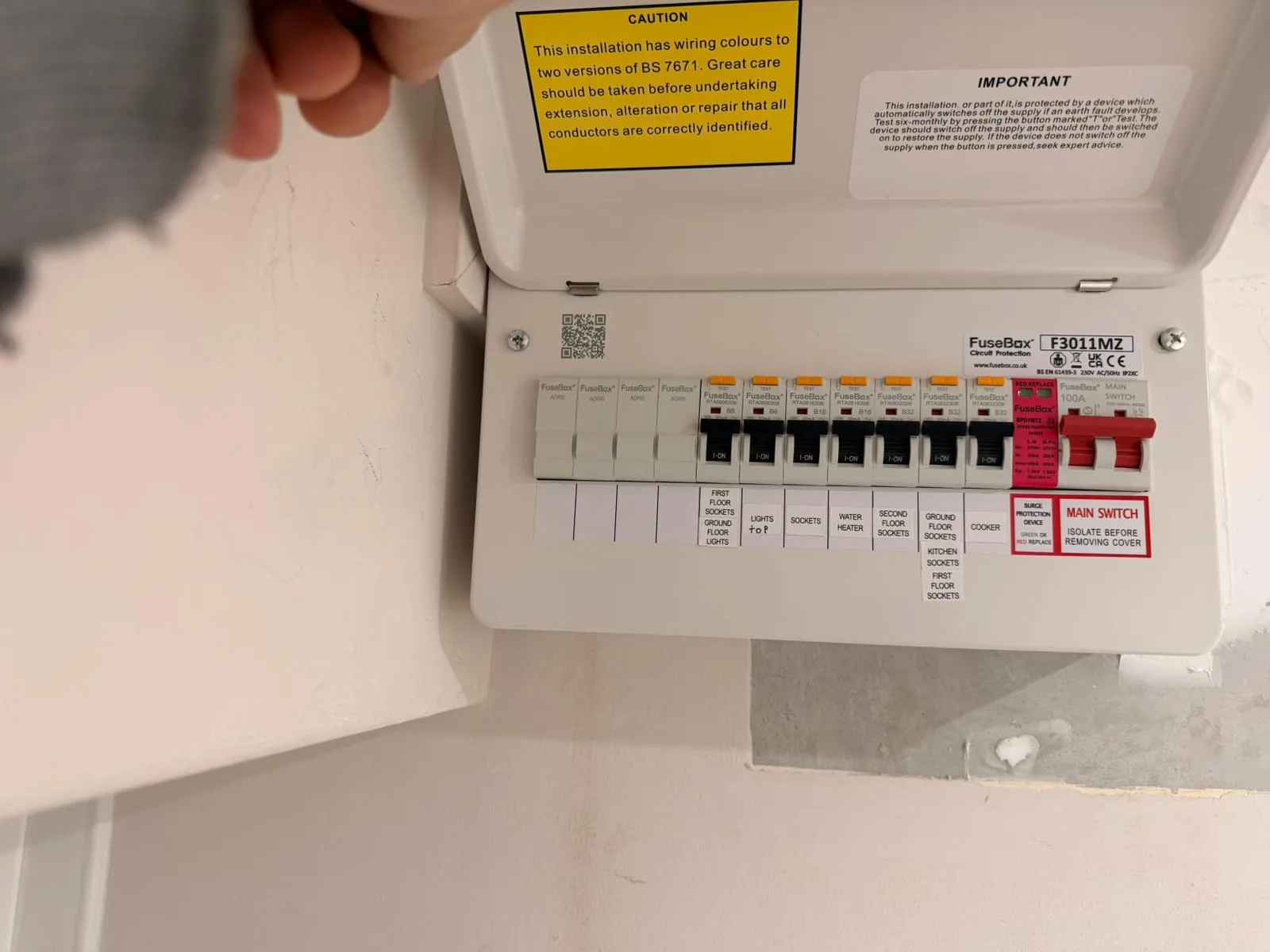
The photograph above shows what a compliant post-upgrade consumer unit looks like: every circuit labelled, surge protection fitted, and the whole installation documented on the certificate. This is the standard BCP Council expects to see on rental properties.
Understanding the coding is critical, because the code dictates the remedial timeline.
| Code | Meaning | Remedial Timeline |
|---|---|---|
| C1 | Danger present, risk of injury | Immediate isolation; remedy ASAP |
| C2 | Potentially dangerous, urgent remedial action required | Within 28 days |
| C3 | Improvement recommended, not a fail | No legal deadline |
| FI | Further investigation required | Within 28 days |
A certificate with any C1, C2, or FI codes is classified Unsatisfactory. C3 codes alone do not fail a certificate. They are recommendations to bring an older installation closer to current standards.
The most common reasons we classify a Bournemouth rental property unsatisfactory:
HMO properties face additional requirements beyond the standard EICR. If you operate a licensed HMO in Bournemouth, your compliance package includes fire alarm certification to the correct BS 5839-6 grade, emergency lighting testing to BS 5266, and in some cases PAT testing of landlord-supplied appliances, all of which we cover under our electrical testing and inspection service.
Our full HMO electrical compliance guide for Bournemouth landlords covers the fire alarm grades, emergency lighting standards, and documentation BCP Council expects at licensing inspections.
The EICR frequency for HMOs remains five years under the 2020 Regulations, but in practice we recommend renewing more frequently for HMOs with high tenant turnover, where accidental damage to accessories is more common and periodic reassurance is worthwhile.
If you are a Bournemouth landlord, work through this list today:
For landlords with multiple properties in Bournemouth, we can schedule inspections back-to-back to minimise travel costs and provide a single invoice, which is particularly useful for portfolios concentrated in one area like Boscombe, Winton, or Charminster.
| Property Type | Typical Cost |
|---|---|
| 1-bed flat | £120 |
| 2-bed flat or flat conversion | £150 |
| 3-bed house | £150 |
| 4-bed house or small HMO | £200 |
| 5+ bed HMO | From £220 (priced per circuit) |
| Commercial premises | From £250 |
Prices are fixed. We quote before arriving and the price includes the full inspection, testing, detailed report, and NICEIC certificate. Multi-property rates are available for landlords with three or more properties.
For full Bournemouth-specific pricing, a property-type decision aid, and BH1–BH11 postcode coverage, see our dedicated EICR Bournemouth service page.
Where an EICR reports C1 or C2 defects, the typical remedial works and their costs:
| Remedial Work | Typical Cost |
|---|---|
| Consumer unit upgrade (full RCD protection) | From £450 |
| Supplementary bonding to water/gas | From £80 |
| Replace broken socket or switch | From £45 |
| Replace burnt or damaged light fitting | From £65 |
| Additional RCD for a single circuit | From £95 |
| Earth rod installation (TT systems) | From £150 |
Most C2 defects can be resolved within the same visit as the EICR, provided our electrician has the necessary materials on the van. For larger works like a full consumer unit upgrade, we book a separate appointment but always prioritise the work within the 28-day window.
BCP Council’s enforcement of EICR regulations is not a future possibility. It is an ongoing activity, and 2026 is the year the first major wave of five-year certificates expires. Landlords who delay renewal past the certificate expiry are non-compliant from day one.
The fix is straightforward: book the EICR before the certificate expires, have any remedial work completed within the 28-day window, and keep copies of every certificate, test result, and tenant acknowledgement.
Get compliant, fast. Message Tim on WhatsApp with your property address and expiring certificate date. We’ll schedule the inspection, complete any remedial works within 28 days, and provide all the documentation BCP Council needs. NICEIC registered, 5.0 ★ on Google, and we cover every Bournemouth postcode from BH1 to BH11, plus Poole, Christchurch, and Wimborne. Call 07809 680068 or message on WhatsApp for a fixed quote.
Civil penalties run up to £40,000 per breach, and breaches stack, so a missing certificate plus a failure to supply it on request can attract separate penalties on the same property.
The regulations took effect for new tenancies on 1 July 2020 and all tenancies by 1 April 2021, and certificates last a maximum of five years, so the first big wave of EICRs is expiring through 2026. An expired certificate means you're non-compliant from the day it lapses, not from the day the council checks.
28 days for C1, C2 and FI coded defects (C1 danger should be made safe on the spot), with written confirmation of the completed work. The council can request your report at any time and you must supply it within 7 days.
A qualified and competent person, in practice an electrician registered with NICEIC, NAPIT or equivalent, whose reports are independently verifiable. BCP Council checks the inspector's registration as part of enforcement.
£150 for a typical 2–3 bed, from £120 for a 1-bed flat and from £200 for a 4–5 bed or HMO. Fixed prices across BH1–BH11. Book via our EICR Bournemouth page.
Tim and his team are happy to answer questions or provide a free, no-obligation quote. 5-star Google reviews and counting.
Tim and his NICEIC-registered team are here to help. Message us on WhatsApp or call 07809 680068 for a free, no-obligation quote.